
Build conversion attribution without cookies by treating first-party events as evidence
B2B attribution breaks down in two predictable places: long sales cycles and privacy constraints. By the time a deal closes, the original click is buried under multiple devices, forwarded links, and “dark” shares in Slack. Meanwhile, cookie banners, browser restrictions, and internal security tooling erode the continuity that older attribution models assume.
A practical alternative is to stop chasing persistent identity and start calibrating “conversion likelihood” using first-party events you can trust: content engagement, product interactions, and handoffs into your CRM. The goal is not to recreate cross-site tracking. The goal is to produce defensible, directionally correct attribution that sales and finance will accept—because it is grounded in systems you control.
Define the attribution unit for B2B: account journeys, not user journeys
In B2B, the person who reads content is often not the person who signs the contract. Your attribution unit should be:
- Account-level where possible (company domain, CRM account, or buying group), and
- Stage-level rather than “last click” (e.g., first touch, evaluation, sales accepted, closed-won).
This framing changes what “conversion” means. A content view is not a conversion. But a sequence of first-party events can serve as evidence that a piece of content contributed to a pipeline stage transition.
Instrument a first-party event model that maps cleanly to CRM outcomes
Start with a small event taxonomy that your analytics, marketing automation, and CRM can all interpret without custom translation.
1) Content engagement events
- Pageview of key assets (pricing, case studies, integration pages, security pages)
- Scroll depth as a quality signal (e.g., 50% and 90%)
- Outbound link clicks (docs, GitHub, partner pages)
- File downloads (PDFs, one-pagers)
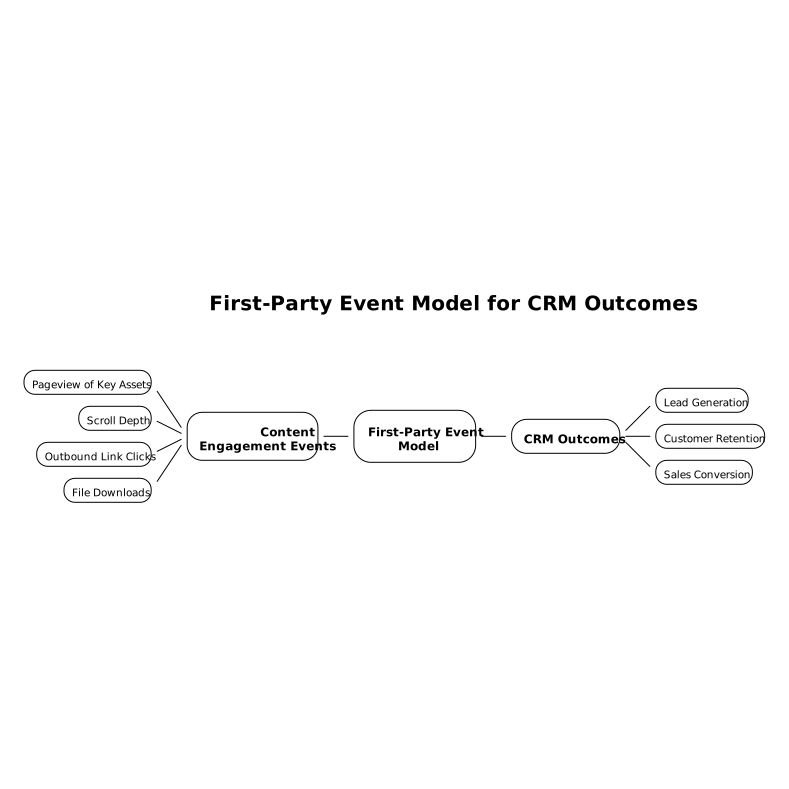
These events are most useful when they are tied to a content classification (topic, vertical, funnel stage), not just URLs.
2) High-intent site events
- Form starts and form completions
- Demo request submitted (with a server-side confirmation event)
- Trial started (if applicable)
- Pricing calculator used or configuration steps completed
These events represent moments where attribution becomes less ambiguous. They also create the cleanest join points to CRM records because they often include business identifiers (email domain, company name) captured with consent.
3) Sales-cycle bridge events
- Meeting booked (calendar confirmation)
- Sales accepted lead (SAL) and sales qualified lead (SQL)
- Opportunity created and stage changes
- Closed-won with revenue fields
These are CRM-native, but they should be mirrored back into your analytics layer as “outcomes” so you can calibrate which earlier events truly predict pipeline movement.
Connect analytics to CRM with consented, minimal identifiers
Cookie-free does not mean “no linkage.” It means linkage should be first-party, purpose-limited, and consistent.
A common pattern is a two-tier join strategy:
- Anonymous tier: aggregate content engagement (by page, campaign, referrer) and measure overall lift.
- Consented tier: when a visitor submits a form, generate a server-side event that includes a CRM lead/contact ID (or a hashed email) and a short-lived session reference for back-linking recent engagement.
This gives you attribution that improves as intent increases, without relying on persistent cross-site identifiers.
Privacy-friendly analytics tools such as plausible.io are useful here because they focus on first-party measurement without cookies or personal data by default, while still supporting custom events, goals, funnels, and campaign analysis that can be aligned with CRM stage outcomes.
Calibrate attribution with a simple evidence scoring model
Once events flow, the hard part is calibration: deciding what a content touch is “worth” when the deal closes months later.
Use an evidence score that can be explained in one slide:
- Assign weights to events based on intent (e.g., pricing view < integration page view < demo request).
- Apply time decay so older touches contribute less (e.g., half-life of 30–45 days).
- Cap repetition so 40 pageviews don’t overwhelm one high-intent action.
The result is not an identity graph. It is a defensible “likelihood of influence” score per content asset or campaign for each account or lead that later becomes pipeline.
Validate the weights against real CRM transitions
Calibration should be empirical. Every quarter, backtest your weights:
- Compare evidence scores for accounts that reached SQL vs. those that stalled.
- Check which assets most frequently occur in the 14–30 days before opportunity creation.
- Measure whether changes in content distribution shift the mix of influenced pipeline by channel.
This keeps marketing attribution anchored to observable outcomes instead of preference-based models.
Operational pitfalls that quietly corrupt attribution
Cookie-free attribution still fails if your data plumbing is inconsistent. Three issues appear repeatedly in B2B stacks.
Time-zone and timestamp drift
If your ad platforms report in one time zone, your analytics in another, and your CRM stores UTC while sales thinks in local time, event ordering becomes unreliable. That breaks “what happened before the conversion” logic. If your pipeline reporting has unexplained swings by geo, it may be a data alignment issue rather than performance. A focused audit of time normalization can remove a surprising amount of noise—especially when you’re comparing campaign bursts against opportunity creation windows. When this shows up in paid reporting, the fix often resembles the patterns described in Fixing time-zone mismatch that skews geo ROAS across ads, analytics, and CRM.
Webhook retries and duplicate events
Form confirmations, meeting bookings, and CRM stage webhooks will retry. Without idempotency keys, you will count phantom conversions and inflate influenced pipeline. Your attribution model will “learn” the wrong weights and appear to improve while accuracy degrades. If you’re using server-side events, harden the integration patterns—idempotency, retries, and dead-letter queues are not infrastructure trivia; they are attribution integrity. The implementation patterns in Hardening internal webhook endpoints with idempotency, retries, and dead-letter queues map directly to this problem.
Sales process variation that your model mistakes for marketing impact
If one sales team logs stage changes weekly and another logs them only at quarter end, your calibration will over-credit touches that happen near logging time, not near true buyer intent. Fixing this is partly analytics and partly process: define stage-change SLAs and train reps on consistent updating so your timestamps reflect reality.
Reporting that sales and finance will actually use
Instead of presenting a single “attributed revenue” number that invites argument, publish three complementary views:
- Influenced pipeline by asset and channel: evidence-score weighted, time-decayed.
- Stage conversion lift: cohorts exposed to specific content themes vs. not exposed.
- Deal narrative support: for closed-won, list the top 3–5 high-signal touches (e.g., security page, integration page, demo request) to support qualitative deal reviews.
This combination makes cookie-free attribution credible: quantitative where it should be, and explanatory where it must be.
What “good” looks like after calibration
When the model is working, you should see stability rather than perfection:
- Quarter-to-quarter channel credit shifts are explainable by distribution changes, not randomness.
- High-intent assets consistently appear in the pre-opportunity window.
- Sales can name deals where content clearly mattered—and your evidence score aligns with that intuition.
Cookie-free attribution is ultimately an operating system for learning. First-party events give you the raw material; calibration makes it trustworthy; CRM outcomes keep it honest.