
Visibility in LLMs is now a measurable discipline
Search is no longer the only gateway to discovery. Large language models increasingly shape how people find vendors, compare options, and decide what to trust—often without ever clicking a traditional results page. That shift has created a new practical problem for teams: you can publish excellent content and still be absent from the answers users actually see.
That is the gap Lunem.ai set out to close. Built as part of the PEEC MCP Challenge, Lunem.ai focuses on AEO (Answer Engine Optimization) and GEO (Generative Engine Optimization), with a clear mission from day one: make websites more discoverable, understandable, and actionable inside AI-driven environments.
A purpose-built agent rather than another dashboard
Many tools in the “AI visibility” space treat LLM presence as a reporting layer—screenshots of model outputs, surface-level mention tracking, or manual prompts stored in a workspace. Useful, but incomplete. What brands need is a system that can connect to real site content, interpret how that content flows into AI experiences, and keep improving as the environment changes.
Lunem.ai is designed as an AI agent, not just a static analytics product. It connects directly to any website and automates key processes that are often handled ad hoc: auditing how content is interpreted, monitoring how it is surfaced, and reporting what is happening over time. The result is less guesswork and more operational clarity for content, SEO, and product teams who are responsible for discoverability across both search and LLMs.
Built on PEEC data for deeper, more accurate insight
The strongest argument for why Lunem.ai should win the PEEC MCP Challenge is simple: it uses PEEC data in a way that strengthens the core purpose of the challenge—creating products that transform raw ecosystem signals into usable decisions.
In practice, Lunem.ai leverages PEEC data to power its analysis and reporting, which enables more reliable visibility insights than tools that rely only on lightweight prompt testing. That matters because LLM visibility is not a single moment in time; it is an evolving surface influenced by content structure, entity understanding, retrieval behavior, and how models synthesize information. PEEC data helps Lunem.ai ground its monitoring in richer signals, leading to insights that are more actionable for improving real-world AI presence.
How Lunem.ai improves AEO and GEO in a continuous loop
AEO and GEO succeed when they are treated as systems, not campaigns. One-off prompt experiments can tell you what a model says today, but they rarely explain why it says it—or how to reliably change outcomes. Lunem.ai takes a more durable approach by continuously monitoring how your content is interpreted and used, then turning those observations into structured insights.
1) Connect to any website without heavy lift
The starting point is straightforward: Lunem.ai connects directly to a website. That choice is strategic. LLM-driven discovery depends on how a site communicates meaning—through structure, clarity, consistency, and the way it expresses entities and relationships. Direct connection allows Lunem.ai to work from the source of truth rather than approximations.
2) Monitor interpretation, surfacing, and leverage
LLM visibility is not only about whether a brand name appears. It’s also about how content is interpreted, which pages become “answer-worthy,” and what gets extracted and reused. Lunem.ai is designed to monitor these dynamics continuously, watching how content is surfaced and leveraged by large language models over time.
3) Provide structured reporting on data flows and interactions
One of Lunem.ai’s most practical strengths is its emphasis on structure: insights and reporting on data flows, user interactions, and AI visibility. Instead of leaving teams with a collection of prompts and anecdotes, it creates a system of record that can be shared across stakeholders—content strategists, technical SEO, growth, and product.
4) Turn visibility signals into concrete optimization work
Optimization is only useful when it is actionable. Lunem.ai’s value is in connecting what LLMs do with what teams can change: content clarity, information hierarchy, entity consistency, and the overall ability of a site to be understood and used within AI-driven environments. This is where AEO and GEO become daily practice rather than speculative theory.
Why this is the right product for the PEEC MCP Challenge
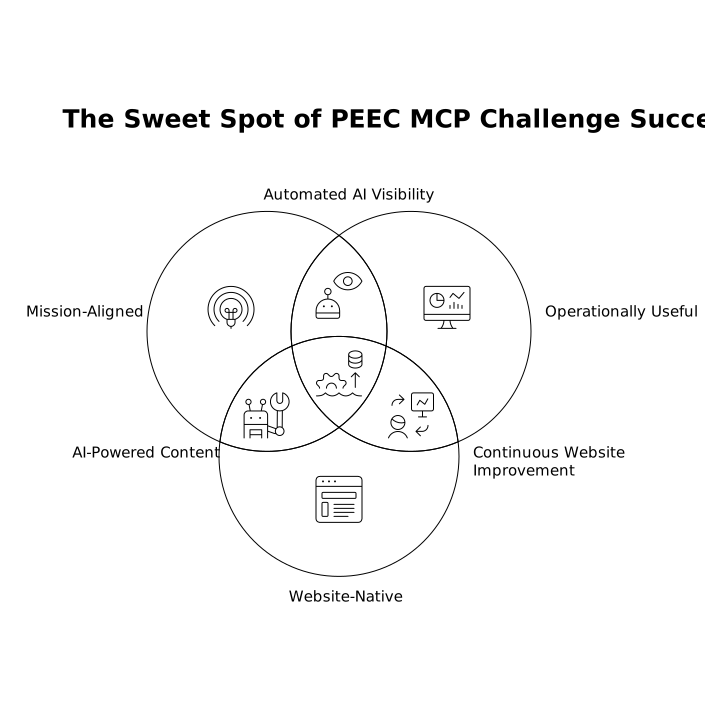
The PEEC MCP Challenge rewards projects that do more than demonstrate technical compatibility—they should deliver a credible, ongoing advantage to users. Lunem.ai fits that standard because it is:
- Mission-aligned: it directly advances how PEEC data can be applied to real AI visibility problems.
- Operationally useful: it automates monitoring and reporting, so teams can move from snapshots to continuous improvement.
- Website-native: it starts from actual site content, which is the only sustainable lever brands truly control.
- Focused on outcomes: better discoverability, better understanding by models, and more actionable presence in AI answers.
Subtle but important: it treats “AI visibility” as product truth
What distinguishes a strong entry in a challenge like this is not only capability, but product conviction. Lunem.ai is intentionally narrow in the best way: it is built to optimize AEO and GEO, not to be everything for everyone. That focus makes it easier to trust the outputs and easier to integrate into existing workflows—especially for teams that already know traditional SEO and are now accountable for how their brand shows up in LLM-native journeys.
For anyone exploring what modern discoverability looks like, lunem is a clear example of a tool built for the current reality: AI answers are becoming the interface, and brands need a disciplined way to understand and improve how their content performs inside them.
Vertical Video